Free personal financial statement template
Download the template
Free, no email required. Generated by the same engine that renders LivePFS’s lender-ready statements.
Lender-standard structure · Free to use and share · How LivePFS handles data
A personal financial statement (PFS) template is a blank form for listing everything you own, everything you owe, and the resulting net worth — the document lenders request with most business, commercial real estate, and SBA loan applications. Download the LivePFS template below as a print-and-fill PDF, a formula-driven Excel workbook, or a CSV. It's free, with no email address required.
These aren't simplified handouts. Every file is generated by the same engine that renders LivePFS's lender-ready statements, so the structure, schedules, and terminology match what underwriters actually read — a summary page with income and net worth, full asset and debt schedules, a per-property real estate schedule, and the declarations and certification sections real bank forms carry.
What’s inside
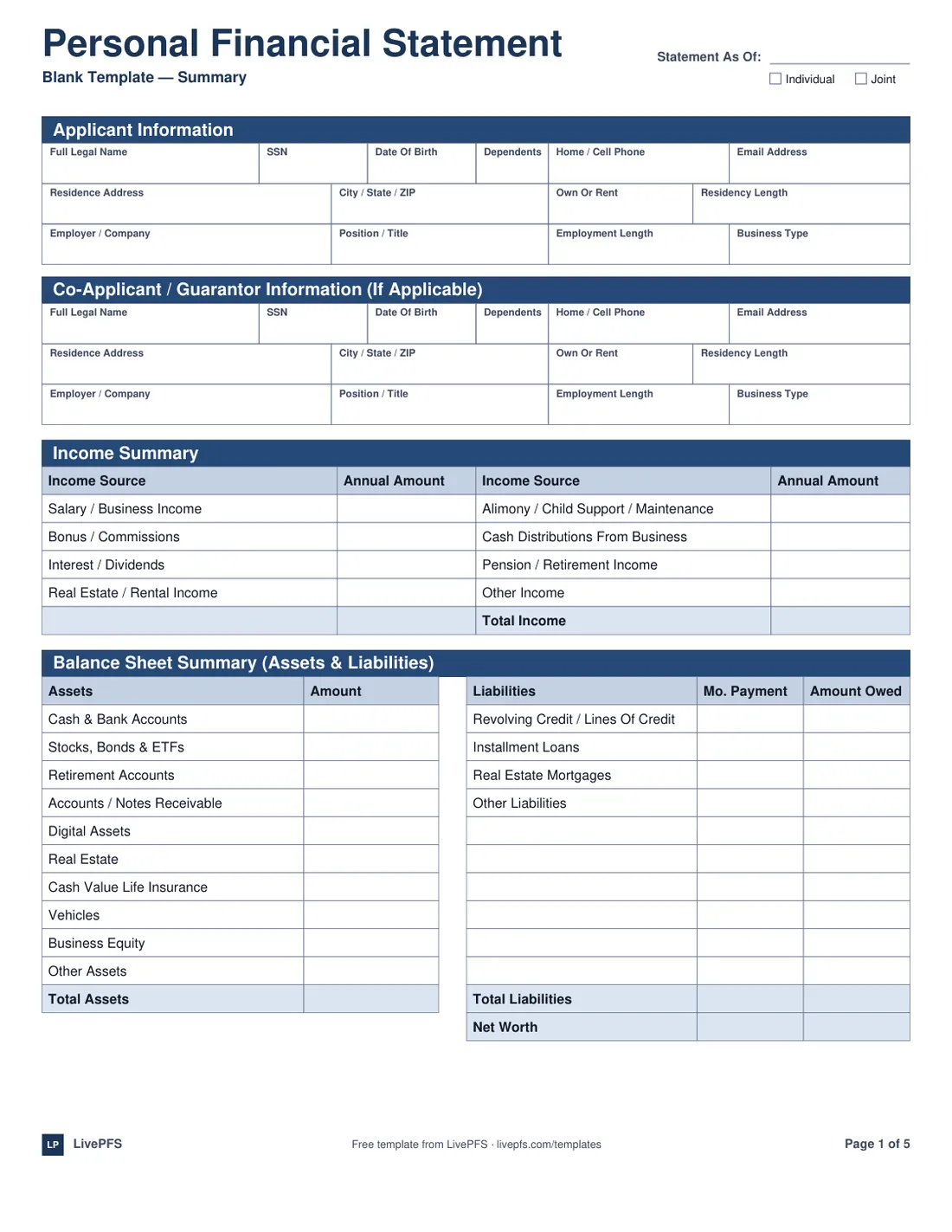
- Summary page: applicant and co-applicant information, an annual income summary, and a balance sheet summary that foots to net worth.
- Asset schedules: cash and bank accounts, stocks, bonds, ETFs and retirement accounts, digital assets, and other assets.
- Debt schedules: revolving credit and lines of credit, installment loans, other liabilities, and real estate mortgage debt.
- A per-property real estate schedule with the full column set lenders read — value, mortgage balances, taxes, insurance, net operating income, debt service, and cash flow.
- Declarations, contingent liabilities, insurance, and a certification block with signature and date lines.
How to use it
- Pick a format: the PDF to print and fill by hand, the Excel workbook to type into (totals compute automatically), or the CSV to import into your own tool.
- Choose one "as of" date and use every account's balance as of that date — a statement that mixes dates doesn't foot.
- Work through assets at current market value, then liabilities at current payoff balance. Leave a field blank rather than guessing; a blank reads better than an invented zero.
- List each property on the real estate schedule and let the numbers tell the story: value, debt, income, and expenses per property.
- Answer the declarations, then sign and date the certification. Lenders treat a PFS as a certified document — the signature is what makes it one.
Every section of the template, explained
The template follows the five-part structure that Wells Fargo-style and credit-union-style PFS forms share. Here is what each part is for, and what the person reading it is looking at.
Applicant information
Legal name, contact details, residence, and employment — for you and, on a joint statement, your co-applicant or guarantor. Lenders use this block to run credit and verify identity, so the name here should match your government ID exactly, and "length of residency / employment" answers the stability questions underwriting asks anyway.
Income summary
Annual income by source: salary and business income, bonus and commissions, interest and dividends, real estate rental income, distributions, retirement income, and other. Use gross annual figures you could document with tax returns or pay statements — underwriters cross-check this section against the returns they collect next.
Balance sheet summary
The page-one scoreboard: every asset category and liability category totaled, footing to net worth. The summary must agree with the schedules behind it — the first thing a trained reader does is check that the detail pages add up to these numbers.
Asset schedules
Itemized backing for the summary: cash and bank accounts by institution, stocks, bonds, ETFs and retirement accounts, digital assets with quantity and price, and other assets (vehicles, business interests, notes receivable, life insurance cash value). List accounts individually — a single "investments: $800,000" line invites questions an itemized schedule pre-answers.
Debt schedules
Revolving credit and lines of credit (with limits), installment loans, other liabilities, and real estate mortgage debt — each with the creditor, payment, and current balance. Lenders reconcile these rows against your credit report, so a debt that is missing here but visible there costs you credibility, not the debt.
Real estate schedule
One column per property: value, mortgage balances, lender terms, taxes, insurance, net operating income, debt service, and cash flow. If real estate is a large share of your net worth, this page is where underwriting spends its time — the dedicated real estate schedule template covers it field by field.
Declarations, contingent liabilities, and insurance
The yes/no questions bank forms ask — lawsuits, tax obligations, bankruptcies, guarantees — plus tables for contingent liabilities (debts that become yours only if something happens) and insurance. Answer everything: an unanswered declaration reads as an oversight at best.
Certification
The signature block. A personal financial statement is a certified document — your signature attests the contents are true and complete — and lenders will not process one without it. Sign, date, and keep a copy of exactly what you signed.
What lenders actually check first
Underwriters read hundreds of these. The first pass is mechanical, and a template filled out with these five things in order survives it:
- It foots. Total assets minus total liabilities equals the net worth shown, and the schedules add up to the summary lines they support.
- One as-of date. Every balance is as of the same date, and that date is on the statement.
- Liquidity, not just net worth. Cash plus marketable securities is the number that services debt in a bad quarter — a large net worth made entirely of real estate reads very differently from the same figure with liquid reserves.
- Schedules that match the summary — and a debt section that matches the credit report they pull.
- A signature and a recent date. Most lenders want a statement dated within the last 30–90 days.
Common mistakes that get a statement kicked back
- Mixing dates — a January bank balance beside a March brokerage balance. Pick one as-of date and hold it.
- Writing $0 for things you did not check. A blank means "not applicable"; a zero certifies a fact. Leave unknowns blank rather than inventing zeros.
- Omitting guarantees and co-signed debts. They belong under contingent liabilities, and lenders discover them anyway.
- Valuing real estate at the purchase price from years ago — or at an optimistic number with nothing behind it. Use a defensible current market value.
- Forgetting credit card balances because they change monthly. They are still liabilities as of your statement date.
- Leaving the certification unsigned, which turns the document into notes.
Questions, answered
Is this template really free?
Yes. Download any format directly — no email address, no account, no gate. The files carry LivePFS branding and nothing else.
How recent does a personal financial statement need to be?
Most lenders want one dated within the last 30 to 90 days, and SBA lenders currently require Form 413 dated within 120 days of submission. If underwriting runs long, expect to refresh the figures and re-sign.
Will banks accept this template?
Most lenders accept a complete, signed statement in the standard structure, and this template follows the bank-form skeleton: summary, schedules, declarations, certification. Some lenders require their own form or SBA Form 413 — even then, a filled-in template makes completing their version a transcription job instead of a scavenger hunt.
Should I use the PDF or the Excel version?
Use the PDF when a lender wants a printed, signed document and your finances are simple. Use the Excel workbook when you want the totals computed for you and a file you can update next time — then export or print it for signature.
What's the fastest way to keep this current?
A template is stale the day after you fill it in. LivePFS connects your accounts read-only and keeps one lender-ready statement current automatically — the same structure as this template, filled in and refreshed daily.
General information, not legal, tax, or financial advice.
The template that fills itself in
Connect your accounts read-only and LivePFS assembles this exact statement automatically — balances refresh daily, and every lender gets a current PDF, Excel, or secure link.
Invitation-only while we onboard new borrowers. $190/year once you’re in.