Free net worth statement template
Download the template
Free, no email required. Generated by the same engine that renders LivePFS’s lender-ready statements.
Lender-standard structure · Free to use and share · How LivePFS handles data
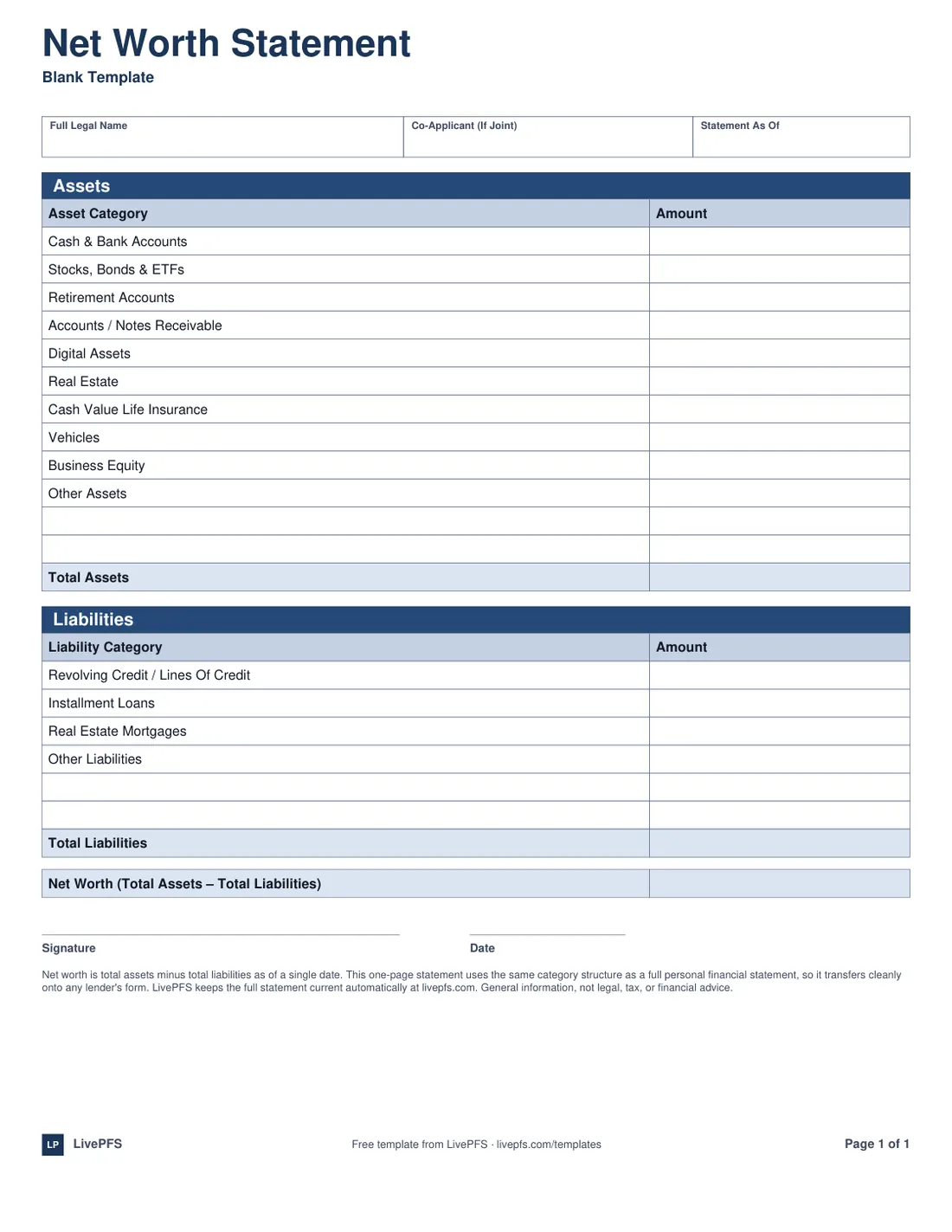
A net worth statement lists what you own, what you owe, and the difference — your net worth — as of a single date. It's the one-page core of every personal financial statement, and the fastest honest answer to "what are you worth?" Download a blank net worth statement below as a print-and-fill PDF, an Excel sheet that computes the totals, or a CSV — free, no email required.
The template uses the same asset and liability categories as a full lender-grade PFS, so a completed net worth statement transfers cleanly onto any bank's own form when a lender asks for more.
What’s inside
- Ten asset categories, from cash and investments to real estate, business equity, and vehicles.
- Four liability categories: revolving credit, installment loans, real estate mortgages, and other liabilities.
- Computed totals and net worth (in the Excel version), plus a signature and date line on the PDF.
- Spare rows for anything your situation adds.
How to use it
- Pick one date and value everything as of that date.
- Enter each asset category's total at current market value — what it would sell for, not what you paid.
- Enter each liability at its current payoff balance.
- Net worth is total assets minus total liabilities; the Excel version computes it for you.
- Date it, and if a lender will see it, sign it.
How to value each category
A net worth statement is only as good as its valuations. The rule for every line is the same — what it is worth today, supportably — but "supportably" means something different per category:
- Cash, bank, and brokerage accounts: the statement balance as of your date. No judgment calls here — use the institutions' numbers.
- Retirement accounts: current market value, gross. Note any loans against a 401(k) on the liability side. Some lenders discount retirement assets in their own analysis because of taxes and penalties — that is their haircut to take, not yours to pre-apply.
- Real estate: a defensible current market value — a recent appraisal, a broker opinion, or comparable sales. Not the purchase price from 2019, and not the number you hope for.
- Business equity and private investments: conservative, with the method in mind (book value, a recent valuation, a buy-sell agreement price). This is the line lenders probe hardest.
- Vehicles and personal property: quick-sale value, not replacement cost. Most readers barely weight this line — don't inflate it.
- Liabilities: current payoff balances, every one of them — mortgages, credit cards, installment loans, and anything else with your name on it.
Net worth is not the number lenders care about most
The bottom line gets the attention, but a reader who does this professionally looks first at composition: how much of your net worth is liquid (cash plus marketable securities), how much is leveraged real estate, and how much is illiquid business equity. Two people with the same net worth can be a world apart in credit terms — the one who can write a six-month reserve check from liquid assets reads as the safer loan. Fill in every category honestly and let the composition speak.
Common mistakes
- Netting things silently — listing real estate at equity instead of value on one side and debt on the other. Assets gross, liabilities gross, and the subtraction happens once, at the bottom.
- Counting the same dollar twice — a brokerage account and the margin loan against it are one asset and one liability, not a bigger asset.
- Skipping small debts. The reader reconciles against a credit report; the $4,000 card balance you rounded away shows up there.
- Using different dates for different lines. One as-of date, stated on the statement.
Questions, answered
What's the difference between a net worth statement and a personal financial statement?
A net worth statement is the summary: assets, liabilities, net worth. A personal financial statement wraps that summary in schedules and disclosures — itemized accounts, a real estate schedule, income, contingent liabilities, and a signed certification. Lenders usually want the full PFS; the net worth statement is the right tool for a quick, honest snapshot.
Do retirement accounts count in net worth?
Yes — a 401(k) or IRA is your asset at its current market value, gross. List loans against it as liabilities. Some lenders apply their own discount for taxes and early-withdrawal penalties when they analyze liquidity, but the statement itself reports the real balance.
Should I list assets gross or net of the debt against them?
Gross, always. The house goes on the asset side at market value and the mortgage on the liability side at payoff — netting them into one "equity" line hides information the reader needs, and every standard form separates them.
How do I value my assets?
Current market value, as of your statement date: account balances from the institutions, real estate at a defensible estimate, vehicles and business interests at what they would actually bring. Be conservative — a lender who catches one optimistic number discounts all of them.
How often should I update it?
At minimum, whenever someone will rely on it. Balances drift constantly, which is why a net worth statement is stale almost immediately — and why LivePFS keeps the full statement version refreshed from your connected accounts instead.
General information, not legal, tax, or financial advice.
Your net worth, without the spreadsheet
Connect your accounts read-only and LivePFS keeps your full statement — net worth included — current every day, ready for any lender.
Invitation-only while we onboard new borrowers. $190/year once you’re in.